Pennant or Scarf for a Small Wall? Choose by Shape and Hang
Pennant or scarf for a small wall? Compare their shapes, hanging options, and visual weight to choose a college keepsake that fits your room.
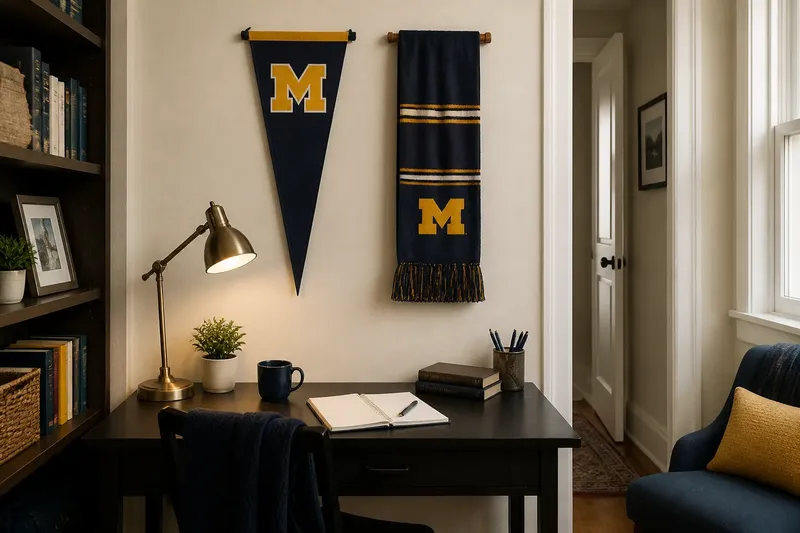
A college pennant above a narrow desk leaves clear space around its pointed end; a folded scarf can fill the same spot with softer edges. If you are choosing a pennant or scarf for a small wall, start with the shape of the space and how much visual attention you want the keepsake to claim.
Which one fits a narrow wall better?
A pennant usually suits a narrow, upright patch because its familiar silhouette already directs the eye. Its long center and tapered tip make a compact display feel intentional, especially beside a bookshelf, doorframe, or desk. Check the pennant’s actual outline against the wall: some are broad, while others are slim enough to sit between furniture and trim.
A scarf is more adaptable, but its width can make a small wall feel crowded if you stretch it flat. Folding it lengthwise creates a vertical band; folding it into a square makes a denser block. The right choice depends on whether the wall has a tall empty strip or a wider, shallow opening.
Use painter’s tape to mark the rough outline of each option before you hang anything. Stand where you usually enter or sit, then notice whether the taped shape competes with nearby art, shelves, or a lamp. The exercise is useful because a keepsake that looks compact in your hand can occupy a surprising amount of visual space on a blank wall.
How do their shapes change the look?
A pennant reads as a single, fixed emblem. Its point gives the display direction, and its school colors or lettering remain easy to recognize from across a room. That crisp outline works well when you want one clear campus mark rather than a broad patch of color.
A scarf has more folds, texture, and movement. Fringe can soften the edges, while stripes or a large wordmark may become partially hidden when the fabric is folded. If the design matters more than the material, hold the scarf in several positions and check which parts remain visible. A flat, open display shows more of the pattern but uses more wall area.
Imagine you have a small study corner with a dark desk and a narrow cream wall above it. You could tape up a pennant outline and a folded-scarf outline, then compare them from the doorway. If the pennant leaves a clean border around the desk, it may make the corner feel ordered; if the scarf’s softer folds tie in with a nearby chair or blanket, its texture may feel more at home.
Which hanging method suits each keepsake?
A pennant often has a natural top edge that can be supported with removable wall-safe hooks, clips, or a slim rod, depending on its construction and your wall. Keeping the top edge level helps the point hang straight. If the pennant curls, avoid pulling hard on its tip; the material may distort, and the silhouette can lose its clean line.
A scarf needs support across enough of its width to keep the fabric from sagging into an unintended shape. A row of clips can hold it in a soft drape, while a hanger or rod can keep a folded scarf more controlled. Use supports that suit the wall finish and the object’s fabric, and avoid adhesive directly on delicate fibers. For a rental wall or fragile keepsake, a freestanding display surface may be a better fit than a wall mount.
Follow the care label, maker’s instructions, and applicable building or rental rules when choosing a support. This matters most when the fabric is delicate or the wall surface is easily marked.
What should you check before choosing a pennant or scarf?
Will the keepsake cover a switch or outlet?
Mark nearby switches, outlets, and door swings before settling on a position. Choose a placement that leaves them accessible and does not let loose fabric hang across an outlet.
Can you see the design from your usual seat?
Look at the proposed display from the chair, bed, or doorway where you will notice it most. If a scarf’s lettering disappears in folds, try another fold or choose the pennant’s clearer outline.
Does the wall already have strong shapes?
A pointed pennant can add another directional edge beside framed art or open shelving. A scarf may blend more gently with soft furnishings, but a broad spread of color can still dominate a crowded wall.
Will you want to change the display later?
A scarf is easy to refold for a new arrangement, while a pennant tends to keep the same recognizable shape. If you like rotating campus objects, choose clips or a freestanding support that makes changes simple without repeatedly altering the wall.
How can you make a small display feel intentional?
Give the keepsake a clear boundary rather than squeezing it into the last available patch. Leave breathing room around its outline, and align one edge with a nearby shelf or frame if the room already has strong horizontal or vertical lines. A small display can feel deliberate without adding more objects around it.
Choose the pennant when you want a compact, legible school symbol with a built-in direction. Choose the scarf when you prefer fabric texture, flexible folds, or a softer visual presence and can support its width. For a small wall, the best pick is not automatically the smaller object; it is the one whose visible shape fits the room’s open space and the way you want the campus keepsake to read.
Before mounting, keep the painter’s-tape outline in place through a normal evening in the room. If you stop noticing it in a good way, the scale is likely comfortable; if it keeps pulling your attention from a work surface or doorway, try a narrower fold or a different wall patch.