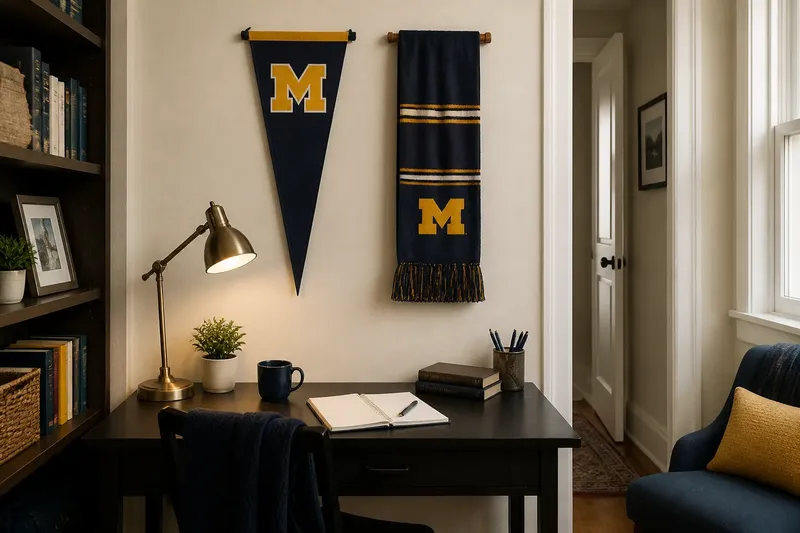
The Matching Set Myth in College Collecting
College collecting feels more personal when a theme, not a matching set, decides what belongs. Choose keepsakes that reflect your campus connection.
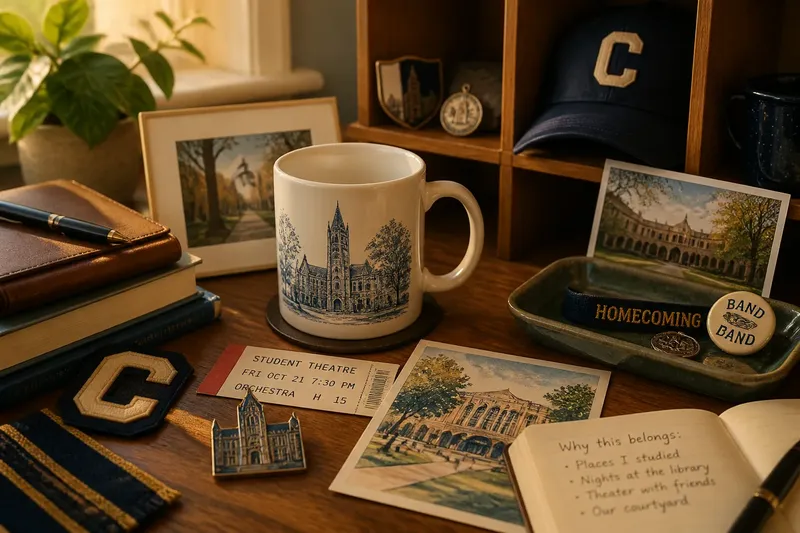
At the campus shop, one mug catches your eye: it has the old library drawn in fine blue lines. The rest of the shelf is a wall of red-and-gold sweatshirts, but that mug feels like yours. College collecting does not require matching colors or a complete series. A personal theme can connect unlike objects and make each choice easier to explain.
The matching-set idea often arrives quietly. A collector buys one school-color item, then feels obliged to find its companions. Or a numbered series begins to look unfinished when one design is missing. That can be a satisfying pursuit if completion itself is the pleasure. But it is not the only way to build a collection, and it need not be the default.
What do you want your collection to remember?
Start with a memory, place, habit, or visual detail—not a product category. “Items in school colors” is a category. “Places where I studied between classes” is a theme. The second can include a map postcard, a library mug, a bookstore bookmark, or a campus building pin, even if their colors and materials clash.
A useful theme has room for different objects but still gives you a reason to say yes or no. It might center on:
- A campus place, such as the student union or a particular courtyard.
- A recurring activity, such as band performances or late-night study sessions.
- A visual detail, such as campus lettering, mascot expressions, or building illustrations.
- A personal connection, such as gifts from friends or keepsakes from visits with family.
- A kind of encounter, such as objects you used, displayed, or carried during a particular part of college life.
Say you keep a ticket stub from a student theater performance and later spot a shop postcard depicting the auditorium. If your theme is “places where I went with friends,” both objects belong for a clear reason, even though one is paper ephemera and the other is a shop item. The theme joins them without requiring a matching color or series.
Which collecting situation sounds like yours?
Do you enjoy finishing a numbered series?
A complete series may fit if the search itself is part of the fun and you enjoy seeing the designs together. Decide what “complete” means before you start: perhaps it is every design currently offered, or only the ones tied to a particular campus tradition. A boundary keeps a limited project from becoming an obligation to chase every related item.
Are you drawn to different corners of campus?
A place-based theme fits if your favorite memories attach to locations rather than one design or product type. Look for objects that name, depict, or evoke those places, such as a campus map, a building postcard, or a pin sold at the visitor center. Their differences become part of the record of moving around campus.
Do you collect around an activity or ritual?
An activity-based theme suits someone whose college connection comes through a repeated event, such as game days, performances, or club meetings. Choose objects that recall your participation or the setting, rather than assuming every item bearing the mascot belongs. This gives the collection a story without demanding identical colors.
Do you want a small, personal group of keepsakes?
A memory-led theme is the better fit if you value reminders over coverage. Keep the object that brings back a specific moment, even if it is the only one of its kind. You can add another later when it connects to the same memory, person, or period of campus life.
How can you decide whether an object belongs?
Use a short decision test while you are browsing. It should help you choose, not create another rigid standard.
- Name the connection. Can you say what the object has to do with your theme in a plain sentence?
- Check the object itself. Does its design, material, location, or use carry that connection, or does it merely share the school name?
- Consider the memory. Does it recall something you experienced, someone you associate with campus, or a place you want to remember?
- Notice the reason for buying. Are you choosing it because you genuinely want it, or because an imagined set feels incomplete?
- Decide where it will go. Can you picture it in a display, in use, or stored with related keepsakes?
- Leave room for change. Would you still be comfortable with the choice if your theme shifts as your connection to campus changes?
Not every answer needs to be yes. The point is to make the connection visible to yourself. If the only reason is “I already have the matching mug,” pause and decide whether matching is truly what you enjoy. If you can name a personal link, the item may fit even when its colors and format do not.
What can connect objects that do not match?
Arrange a collection by meaning rather than appearance. A shelf can group objects from one place; a small tray can hold items tied to one activity; a folder can keep paper pieces from the same stretch of campus life. The organizing choice should make the link easy to see, not force every object into the same visual style.
Labels can help when the connection is not obvious to a future viewer. A small card beside a display might name the location or occasion. For paper keepsakes, a note on an archival-safe sleeve can record why you kept the piece. Keep the explanation brief: “Courtyard where our club met” says more than a generic label such as “college memorabilia.”
Materials also affect how you group and store things. A ceramic mug, fabric patch, and paper ticket may belong to one theme but need different care and display choices. Follow the maker’s care guidance for a specific object, and use appropriate storage materials for delicate paper or fabric. The theme can be shared even when the objects cannot be stored together.
When is a matching set still the right choice?
Matching is a valid preference, not a collecting rule. A coordinated set can look composed on a desk or make a satisfying record of a series you deliberately chose to follow. If you enjoy finding each edition and seeing the colors align, let that pleasure lead. The problem is not matching; it is treating a missing piece as a failure when you never wanted the whole set in the first place.
You can also combine approaches. Keep a small run of matching campus pins within a broader collection about student traditions. The pins form a set, while the wider theme allows in a program from a performance or a postcard from the student center. This gives the collection both visual order and room for personal associations.
How can you keep a flexible theme from becoming too broad?
A theme needs a boundary, but the boundary can be personal rather than visual. Add a phrase that narrows the subject: “campus places where I spent time with friends” is more selective than “anything from college.” Other useful limits include a particular activity, a relationship, or objects you actually encountered during a chosen period.
When a new item seems close but not quite right, write down why you are considering it. If the reason is only that it carries the school name, it may be a souvenir you like rather than part of this collection. You can still buy it; you do not have to assign every purchase a place in a theme.
College collecting becomes easier to shape when the question changes from “What matches?” to “What connection do I want to keep?” A theme based on places, rituals, or personal memories gives mismatched objects a clear place while leaving you free to pass on a full series. The next time a shop shelf catches your attention, name the connection before you decide what belongs.